By Emil Petersen, Sales & Marketing Officer at Innoventum. Updated November 2026.
Short answer: Solar panels on the roof are usually the cheapest per kWp, but only if the roof can support the weight, is in good condition, faces the right direction, and isn’t shaded. A solar carport costs more for the structure but also provides a roof over the parking space—a natural location for charging stations—and electricity without anyone having to touch the building’s roof. Many properties are best off starting with the roof and adding a carport once the roof is full or unsuitable.
A Comparison of Solar Carports and Roof-Mounted Solar Panels
| Solar panels on the roof | Solar Carport | |
|---|---|---|
| Area in use | Roof area | The Parking Lot |
| Cost per kWp | Lower—the ceiling is already there | Higher; the frame is added |
| What You Get in Addition to Electricity | Nothing | A roof over the cars and a place to charge them |
| Production per location | It depends on the roof's orientation and pitch | Approximately 3 kWp and 3,100 kWh per parking space per year in southern Sweden |
| Direction | Determined by the ceiling | Can be chosen freely in the parking lot |
| Panels | Usually single-sided | Bifacial, also generates power from the back side |
| Requirements for the Property | The roof must support the load and last another 25–30 years | No impact on the building |
| Fire Safety | To be assessed for the roof and the building | Detached from the building |
| Building Permit | In principle, no building permit is required if the panels follow the shape of the roof | Requires a building permit if it is larger than 30 m² (50 m² outside the zoning plan), which in practice means for more than two cars |
| Charging for Electric Cars | Cables must be run to the parking lot | Charging stations can be installed directly in the carport |
| Visibility | Rarely seen | Visible to everyone who parks |
When is the best time to install solar panels on the roof?
The roof is the first choice when it meets three criteria:
- Load-bearing capacity. The roof must be able to support the weight of the panels plus the snow load. On many lightweight warehouse and industrial roofs, there is no margin left.
- Lifespan. Solar panels last 25–30 years. If the roof needs to be replaced during that time, the panels must be removed and reinstalled, which is costly.
- Orientation. The roof should face south, east, or west and should not be shaded by taller buildings, trees, or rooftop installations.
If the roof meets all three criteria, it is generally the cheapest way to generate solar power.
When is a solar carport the best option?
- The roof isn't adequate. It's full, too flimsy, shaded, or due for renovation soon.
- You need charging stations. Starting in 2025, commercial buildings with more than 20 parking spaces must have at least one charging station, and starting in 2027, the requirements for parking garages will be stricter. Learn more about the 2027 requirements for charging stations.
- The parking lot is large and currently unused as a solar installation site. A 40-space parking lot can accommodate approximately 120 kWp and generate 124,000 kWh per year.
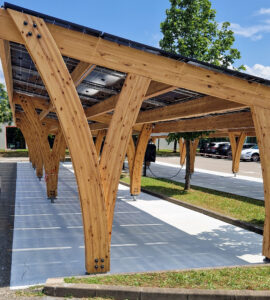
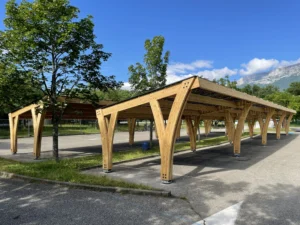
- You want sustainability to be visible. A glulam carport at the entrance is visible to all visitors, employees, and customers.
- The property is leased or owned by someone other than the person who wants to generate the electricity. The carport does not affect the building.

How much electricity does a solar carport generate compared to a roof?
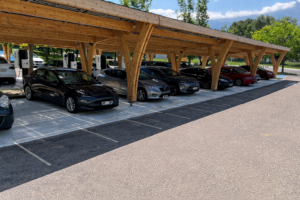
A solar carport from Innoventum generates approximately 3 kWp and 3,100 kWh per parking space per year in southern Sweden. Since the carport is freestanding, it can be angled toward the south even if the building faces a different direction.
The panels are bifacial and also capture light reflected from the ground beneath the carport. With a light-colored or highly reflective surface beneath the roof, energy production can increase by up to 15% under favorable conditions. On a roof, the panels are usually placed directly against the roof surface, where the back side receives no light.
How much does it cost?
Per installed kWp, rooftop solar panels are almost always the cheapest option, since the roof is already there. But a solar carport shouldn’t be compared to a rooftop on a like-for-like basis. It transforms a space that currently lies idle—the parking lot—into an energy hub that creates value and revenue every day:
- Lower electricity costs. Solar power is used directly in the building or for charging during the day, rather than being purchased from the power grid.
- Revenue from charging. Employees, customers, or tenants pay to charge their vehicles, and the parking lot becomes a source of revenue in its own right.
- Charging requirements are met as part of the deal. The charging stations get a roof, a location, and cable routing—all as part of the same investment.
- A property with added value. A covered parking area with charging stations and on-site electricity generation makes the property more attractive to tenants and buyers.
- No work on the building. No risk of leaks, and no cost to remove the panels when the roof needs to be replaced.
The roof generates electricity. A solar carport provides electricity, charging, and shelter for your cars—all on a space you already own.
A solar carport from Innoventum is mounted on ground screws and installed directly on existing asphalt. The parking lot does not need to be dug up, and it can be used throughout most of the construction period.
What are the requirements for building permits and fire safety?
Roof-mounted solar panels typically do not require a building permit if they follow the shape of the roof. However, within a zoning plan, a permit may still be required for buildings other than single-family homes—for example, when the roof faces a street or public square—and always in areas of cultural and historical significance. Notification may be required if the installation affects the load-bearing structure or fire safety, so fire safety must always be assessed.
A solar carport is considered a building. Starting December 1, 2025, businesses and property owners other than single-family homeowners will also be allowed to build small ancillary structures without a building permit: up to 30 m² per structure and 45 m² in total within a zoning plan, and 50 and 65 m², respectively, outside a zoning plan. For buildings other than single-family homes, the structure must also comply with the zoning plan. A solar-powered carport takes up about 14 m² per parking space, so even a carport for three cars is larger than 30 m², and one for ten cars is about 140 m². In practice, therefore, a building permit is required for a business parking lot. Innoventum prepares the drawings, structural calculations, and snow and wind load analyses required by the municipality. Check with your local municipality to find out what applies to your specific property.
What does the EU say about solar panels on buildings and parking lots?
The EU’s Building Directive sets requirements for solar energy where it is technically and economically feasible. This applies, among other things, to new commercial buildings larger than 250 m² by December 31, 2026, and new covered parking structures adjacent to buildings by December 31, 2029. These requirements must be incorporated into Swedish law. If the roof lacks space or structural capacity, the parking structure may be the natural location for solar panels.
Is it possible to combine the two?
Yes, and for many properties, that's the best option. A common arrangement:
- Start with the part of the roof that is load-bearing, in good condition, and properly aligned.
- Build a solar-powered carport in the parking lot where the charging stations will be located.
- Connect both to a control system so that the solar power is used where it's needed—in the building or in the cars.
Five Questions That Will Decide the Election
- Can the roof support the weight of the panels and the snow load?
- Will the roof need to be replaced or renovated within 25 years?
- Do you need charging stations now or in a few years?
- Do you own both the building and the parking lot?
- Do you have a parking lot in a sunny location with at least 10 spaces?
If you answer “no” to the first two questions and “yes” to the rest, there’s a strong case for a solar carport—either on its own or in combination with the roof.
Frequently Asked Questions
Which is cheaper: a solar carport or solar panels on the roof?
Per kWp, a roof is usually the cheapest option, since the roof is already in place. A solar carport, on the other hand, provides both a roof over the parking space and a place to charge, which makes for a more even comparison.
How much electricity does a solar carport generate per parking space?
Approximately 3 kWp and 3,100 kWh per parking space per year in southern Sweden.
Does a solar carport require a building permit?
Yes, in a company parking lot, practically always. Structures that do not require a building permit may be no larger than 30 m² within a zoning plan and 50 m² outside of one, and a solar carport takes up about 14 m² per parking space. Solar panels installed on an existing roof typically do not require a building permit.
Can you charge electric cars directly from a solar-powered carport?
Yes. The charging stations can be installed in the carport, and solar power is used directly for charging when the sun is shining.
Does a solar carport affect the building?
No. The carport is freestanding on ground screws, so the property’s roof, load-bearing capacity, and fire safety are not affected.
Would you like to know what's right for your property? Solar Carports for Businesses | All Solar Carports | Request a Quote